
The Secret to Great Business Writing? (Hint: It isn’t Grammarly)
Early this year I signed on to teach business writing for the first time. I had zero teaching experience, a curriculum that I cooked up myself, and a plan to channel my high school French teacher.
What happened next surprised me.
Here’s what I learned about the real secret to good business writing. It’s not about grammar. Or syntax. Or clever bullet points.
The Secret to Great Business Writing? (Hint: It isn’t Grammarly)
“I have a confession to make,” I told my business writing students in the final ten minutes of the final class in our 12-week online course: “I’ve never taught business writing before—in fact I’ve never taught ANYTHING before in my life.”
Twelve weeks earlier, as I approached my first Zoom class, I did what any first-time teacher would do: I panicked. Kidding!
I channelled my favourite teacher of all time. I channelled Miss Griffiths.
Miss Griffiths taught high school French. She literally danced down the aisles in the classroom as we learned the vocabulary in French songs such as Champs-Élysées, Un éléphant sur mon balcon, and Chic’s immortal Le Freak. She decided that everyone in our class would be a French journalist and had us report the news—Les Nouvelles. Miss Griffiths even took us to a French restaurant in Toronto so that we could taste the language that turns frogs legs into cuisses de grenouille.
I wanted my students to learn how to write so that readers would pause to savour their words as if they were delectable cuisses de grenouille. Miss Griffiths’s joy, creativity, and sense of fun were my beacons as I developed teaching materials for my class. Sadly, there are no “I-hope-that-you’re-well” songs deriding the worst opening line for any email. And there are no virtual restaurants offering PowerPoint a la Baloney with a jargon glaze. But Weird Al’s “Word Crimes” helped me sell the Oxford comma, Grammarpardy gamified grammar rules, and everyone became ad agency executives tasked to produce digital ads for their personal brands.
It’s a special type of person who takes a course like Business Writing at the University of Toronto’s School of Continuing Studies. It’s someone devoted to learning and growing and developing new skills. Students came from across Canada—from British Columbia to Calgary—to Toronto and Montreal (via Newfoundland). One was a yacht stewardess who Zoomed in from assorted locations in the Caribbean.
Teaching over Zoom is like swimming in a spacesuit: you get an approximation of the real experience, but the possibility that your mask will fog up or your spacesuit will spring a leak is ever present. I tried to bridge the technological gap by meeting one on one over Zoom with each student and discovered that everyone had parts of themselves that they kept hidden in their writing. At first, most wrote in a sterile “businesslike” voice as if they were afraid they may infect others with their personality. Fear of appearing quirky, vulnerable, or unprofessional results in business writing as cosplay that reads like quasi-formal gibberish. The reader can’t help but flip their brain’s emergency off switch.
Everyone in my class had a story to tell, and when they did, their writing came alive. Cherise discovered that compliance audits have dramatic possibilities and native plant gardening and labs have much in common. Erin connected with kindred spirits when she shared how she loved playing office as a little girl. And Barath’s first day on a cybersecurity job coincided with a cyberattack with a plot twist: the hackers wanted early access to their favourite tv show.
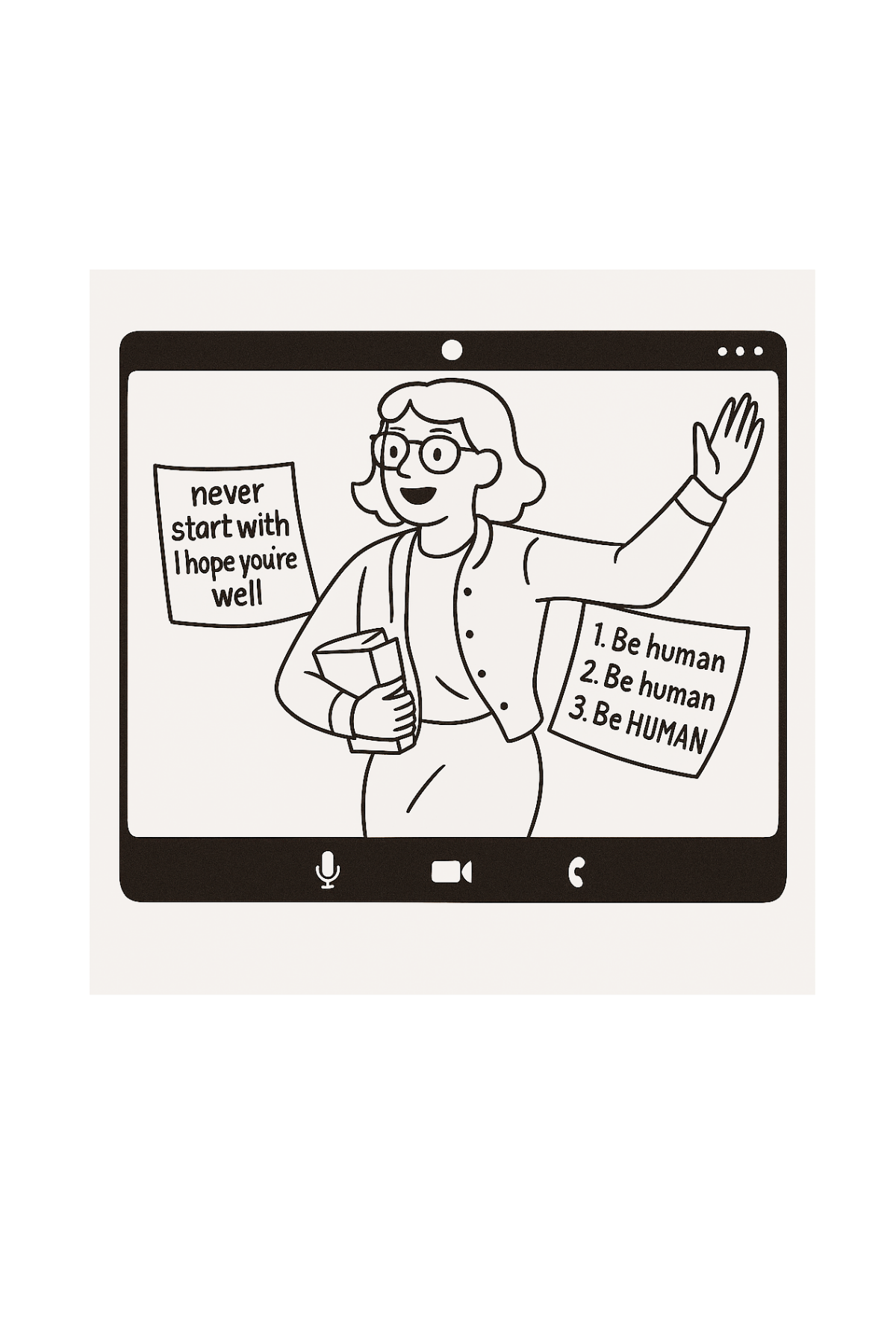
My students made me see in stark reality what I understood in theory: that great business writing isn’t about business. It’s about creating connection and trust through daring to share what makes us human.
As soon as students had the confidence to drop their professional masks and allow their true selves to tell a story in a voice that sounded like the most polished version of their speaking voice, their writing went from robotic to hypnotic. Students didn’t have to turn a report into a personal memoir recalling childhood trauma. Something as simple as using a metaphor from a passion for gardening or cooking or mountaineering and applying it in a business context was enough to create something memorable.
Mike—also known by his Zoom name M9769359–went a step further to blend the personal and professional in an essay that carried the reader from parenting to global supply chains to grief and back again. His words, describing the vertigo of living in a chaotic world while trying to give his children the comfort and resilience they’ll need in the years ahead gave me the cuisses de grenouille pause:
Close your eyes for a moment. The vertigo recedes. Steady now. Sure footed. One foot before the next. We will get them to where they need to be.
No AI bot can replicate the passion of your lived experience or the relationship with the person at the other end of your email. When you bring your full self to the page, your writing becomes captivating.
So what’s the takeaway from 12 weeks of business writing? Business writing isn’t about business. It’s about having the confidence to write like a human who values connection over convention.
And it’s about never opening a email with the line, “I hope you are well.”